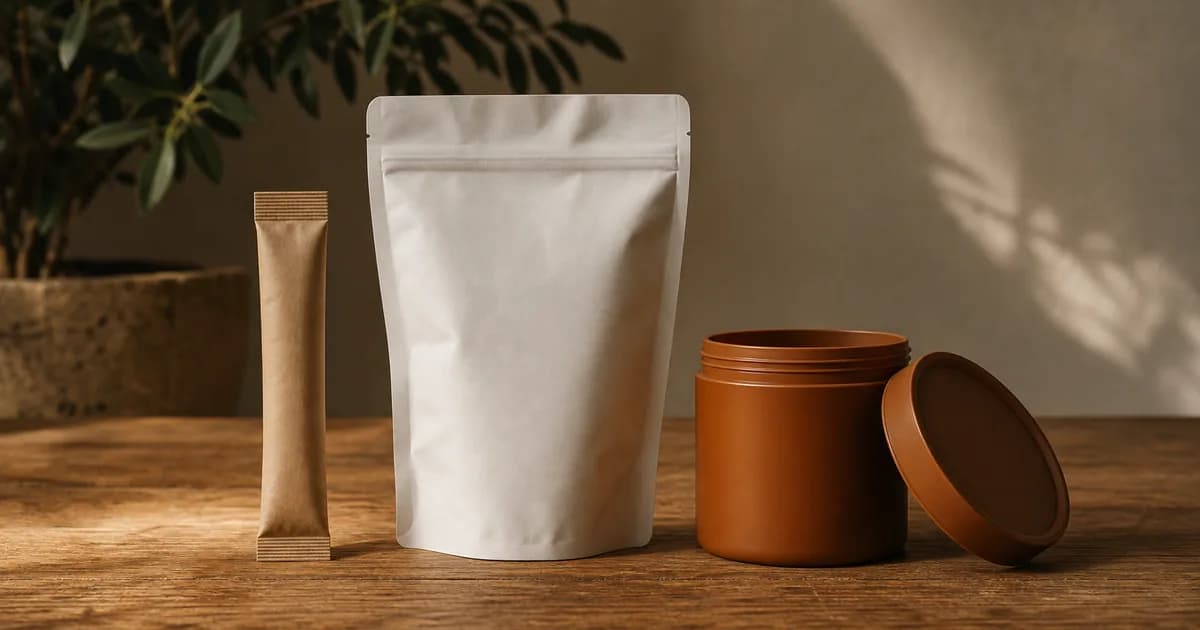
The quick answer: stick packs are the default launch format (about 70% of our orders) because they're portable, sample well, and feel premium. Pouches win for subscriptions at $30–$45 per 20–30 servings. Tubs have the lowest per-serving cost and fit gym and supplement-store retail. Launch with one format, then add a second once customers ask for it.
Key facts
- Stick packs retail at $1.50–$3.00 each, or $25–$45 for a 20–30 pack box
- Pouches (20–30 servings) retail at $30–$45 and fit subscription models best
- Tubs (30–60 servings) retail at $35–$55 with the lowest per-serving manufacturing cost
- A 60-serving tub adds $5–$10 in shipping, which squeezes e-commerce margins
- The same formulation works across all three formats; only the container changes
Packaging isn't a detail you figure out after the formula is done. It shapes your price point, your distribution channels, your customer experience, and your manufacturing costs. We've seen brands pick the wrong format and end up with a great product that doesn't sell because the packaging doesn't fit how their customers actually buy.
Here's what we've learned from producing millions of units across all three major formats.
Stick packs: the default for a reason
About 70% of our orders are stick packs. They're single-serve, portable, and feel premium. Tear one open, pour it into a water bottle, and go. There's a reason the biggest brands in the space (Liquid I.V., LMNT, Drip Drop) all started with stick packs.
Best for:
- E-commerce and DTC brands (easy to ship, no breakage risk)
- Retail shelf placement (hang on clip strips, fit in impulse-buy displays)
- Sampling and events (hand someone a stick pack, they'll actually try it)
- Subscription boxes and gift bundles
- Corporate branded giveaways
Economics: Stick packs typically retail for $1.50–$3.00 each when sold individually, or $25–$45 for a 20–30 pack box. Your manufacturing cost per unit is higher than bulk formats because each stick pack needs its own seal, its own printed film, and its own fill cycle. But the retail margin per unit is also higher.
The catch: If a customer uses your product daily, buying 30 individual stick packs per month gets expensive. Repeat customers will eventually do the math and look for a better per-serving deal. That's where multi-serve formats come in.
Pouches: the subscription-friendly format
Stand-up pouches (also called doypacks) hold 20–30 servings with a resealable zip closure. The customer scoops out a serving, seals it back up, and puts it in the cupboard. It's the format you see in protein powder brands, greens blends, and increasingly in electrolyte products.
Best for:
- DTC subscription models (lower cost per serving = better retention)
- Customers who use the product daily at home
- Brands positioning on value ("30 servings for $35" sounds better than "30 stick packs for $60")
- Amazon and marketplace sellers (one SKU, not 30 individual units)
Economics: A 30-serving pouch might retail for $30–$45. Your per-serving manufacturing cost drops significantly compared to stick packs because you're filling one container, not 30. The trade-off is that your retail price per serving is also lower ($1.00–$1.50 vs $1.50–$3.00 for stick packs), so your absolute margin per unit is similar even though your cost structure is better.
The catch: Pouches don't work for on-the-go use. Nobody's carrying a pouch and a scoop to the gym. They also don't sample well. You can't hand someone a pouch at a trade show. And for retail, they need shelf space that stick pack boxes don't require.
Tubs: the gym and fitness staple
Tubs (typically 30–60 servings) are the traditional format for sports nutrition. They're the big plastic containers you see on supplement store shelves. They signal "serious product" to fitness-oriented consumers.
Best for:
- Gym and fitness studio retail (front desk sales, pro shops)
- Customers who mix at home or at the gym
- Supplement store distribution (GNC, Vitamin Shoppe, local health stores)
- Brands competing in the sports nutrition space specifically
Economics: Tubs have the lowest per-serving manufacturing cost of the three formats. A 60-serving tub might retail for $35–$55. But tubs are heavier and bulkier to ship, which eats into margins for e-commerce brands. If you're selling through retail stores, this matters less because the retailer handles shelf space and the customer carries it home.
The catch: Tubs are a harder sell online because shipping costs are real. A 60-serving tub weighs 300–500g before packaging. That's $5–$10 in shipping for a $40 product. Tubs also don't feel premium the way stick packs do. They feel utilitarian. If your brand positioning is lifestyle or wellness (rather than performance sports nutrition), a tub might send the wrong signal.
Side-by-side comparison
| Stick packs | Pouches | Tubs | |
|---|---|---|---|
| Servings per unit | 1 | 20–30 | 30–60 |
| Typical retail price | $1.50–$3.00 each | $30–$45 | $35–$55 |
| Per-serving cost to manufacture | Highest | Medium | Lowest |
| Shipping weight | Light | Medium | Heavy |
| Portability | Excellent | Poor | Poor |
| Sampling / events | Excellent | Not practical | Not practical |
| Subscription fit | Good | Excellent | Good |
| Retail shelf appeal | High (compact) | Medium | High (visible) |
| Premium feel | High | Medium | Low–Medium |
You don't have to pick just one
Plenty of brands offer multiple formats. A common approach: launch with stick packs to test the market and build brand recognition, then add a pouch or tub SKU for repeat customers who want better per-serving value. The formulation stays the same. You're just changing the container.
That said, don't launch with three formats on day one. Each format is a separate SKU with its own packaging design, its own inventory to manage, and its own minimum order. Start with one, sell through it, and add formats based on what your customers actually ask for.
Our recommendation by business type
E-commerce / DTC brand: Start with stick packs. They're easy to ship, they photograph well for social media, and they work as samples, gifts, and bundles. Once you have repeat customers, add a pouch option for subscribers.
Gym or studio selling in-person: Stick packs for impulse buys at the front desk. If you want a larger format for serious athletes, add a tub. Skip pouches unless you're also selling online.
Corporate / events: Stick packs. Nothing else makes sense for giveaways and branded items. The 1,000-unit minimum on our white-label service was designed for exactly this use case.
Amazon / marketplace seller: Pouches or stick pack boxes. Amazon customers compare per-serving price aggressively, so the pouch format's better value proposition helps you compete. Include a few individual stick packs in a sampler listing to drive trial.
Retail distribution: Stick pack boxes for checkout displays and endcaps. Tubs if you're going into supplement or sports nutrition stores where the format is expected.
Packaging design matters at every size
Whatever format you choose, the label needs to look professional, be regulatory-compliant, and communicate your brand in the 2–3 seconds a customer spends looking at it. Our packaging design service creates print-ready artwork for all three formats, including Supplement Facts panels, regulatory copy, and brand design.
Not sure which format fits your brand? Get in touch and tell us about your target customer, distribution channels, and budget. We'll recommend the format that makes the most sense for your situation.