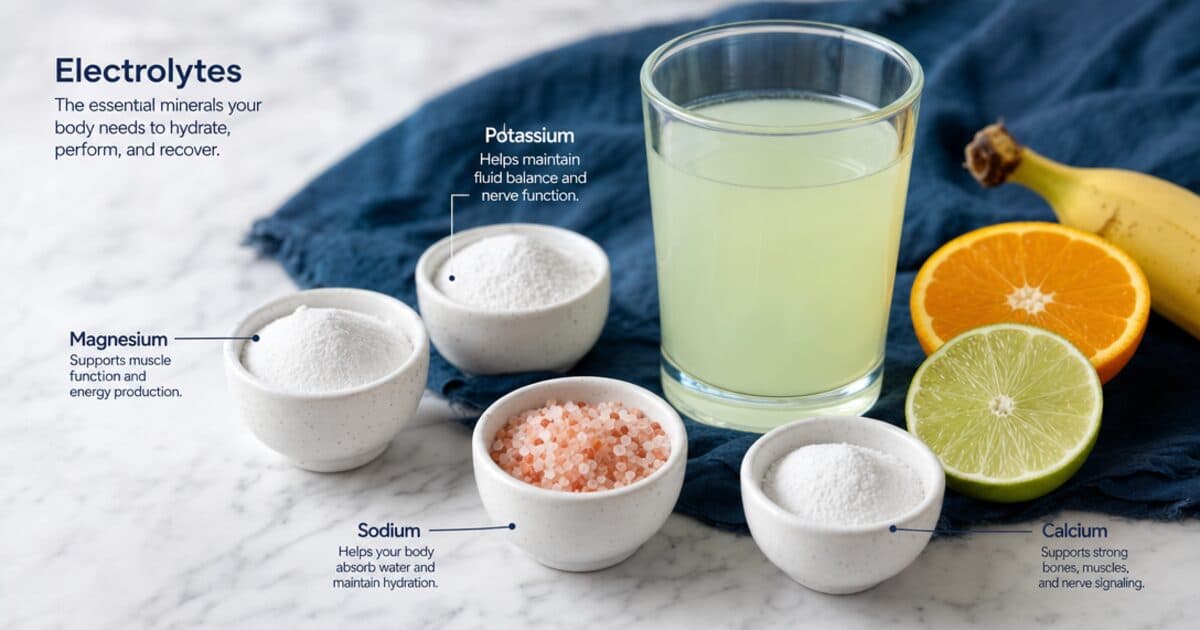
An electrolyte drink mix is built around four minerals: sodium (300–500mg per serving for general hydration, 500–1,000mg+ for athletes), potassium (50–200mg), magnesium (30–100mg), and calcium (20–100mg). Ingredient form matters as much as dose. Citrate forms dissolve and absorb well; oxide forms are cheap and poorly absorbed.
Key facts
- An average person loses 400–700mg of sodium per hour of moderate exercise; hard-training athletes can lose 1,000mg+
- The FDA caps potassium at 99mg per serving in supplement form
- Roughly 50% of Americans don't get enough magnesium from diet alone
- Magnesium citrate and malate absorb well; magnesium oxide is cheap and poorly absorbed
- Avoid proprietary blends: a panel that hides individual mineral amounts can't be evaluated
Every electrolyte brand puts "electrolytes" on the label. Very few explain what's actually in the formula or why those amounts were chosen. If you're launching a product, you should understand what each ingredient does, because your customers will ask, and "it's got electrolytes" isn't a real answer.
Here's what's in most electrolyte formulations and why it matters.
Sodium: the one that does the most work
Sodium is the primary electrolyte lost in sweat. An average person loses 400–700mg of sodium per hour during moderate exercise. Hard-training endurance athletes can lose over 1,000mg per hour. If your product doesn't replace a meaningful amount of that, it's flavoured water with a supplement label.
Most mainstream electrolyte products contain 200–500mg of sodium per serving. That's fine for casual hydration. For endurance athletes, sports performance, or medical rehydration, you want 500–1,000mg+ per serving.
The form matters too. Sodium citrate is the most common in drink mixes because it dissolves cleanly and has a neutral taste. Sodium chloride (table salt) works but adds a noticeable salty flavour. Sodium bicarbonate can help with buffering during intense exercise but causes stomach issues in some people.
Our recommendation: if you're targeting general wellness consumers, 300–500mg of sodium per serving hits the sweet spot. If your audience is athletes or outdoor workers, go higher. Our electrolyte formulations range from 250mg to over 1,000mg sodium per serving to cover both markets.
Potassium: important but tricky to dose
Potassium is the second most abundant electrolyte in the body. It's critical for muscle contraction, nerve signalling, and fluid balance. Most adults need 2,600–3,400mg per day (the Daily Value is 4,700mg, which almost nobody hits through diet alone).
Here's the problem: the FDA limits potassium in supplement form to 99mg per serving unless specific conditions are met. That's not a manufacturing limitation. It's a regulatory one. High doses of supplemental potassium can cause cardiac issues, and the FDA takes that seriously.
So when you see an electrolyte product with 200mg of potassium per serving, that's formulated as a food product, not a dietary supplement, or it's using a potassium-rich ingredient (like coconut water powder) where the potassium comes from the food matrix rather than an isolated supplement form.
For most electrolyte drink mixes, 50–200mg of potassium per serving is realistic and safe. Potassium citrate is the most common form. It dissolves well and has good bioavailability.
Magnesium: the one everyone's deficient in
Roughly 50% of Americans don't get enough magnesium from their diet. It's involved in over 300 enzymatic reactions, including muscle relaxation, sleep quality, and energy production. Adding magnesium to an electrolyte formula is a smart move because the deficiency is so widespread.
Forms matter a lot with magnesium. Here's a quick comparison:
| Form | Bioavailability | Notes |
|---|---|---|
| Magnesium citrate | High | Good all-rounder, can be laxative at high doses |
| Magnesium glycinate | High | Gentle on stomach, popular for sleep formulas |
| Magnesium malate | High | Often used in energy and recovery products |
| Magnesium oxide | Low | Cheap but poorly absorbed, mostly useful as a laxative |
| Magnesium L-threonate | High | Crosses blood-brain barrier, expensive, used in nootropics |
If you're building an electrolyte product, magnesium citrate or malate are the best choices for most applications. Skip magnesium oxide. It's cheap for a reason.
Typical dosages in electrolyte mixes: 30–100mg per serving. That's not a full daily dose (the DV is 420mg for men, 320mg for women), but it contributes meaningfully, especially if your customer is taking it daily.
Calcium: usually included, rarely the star
Calcium is an electrolyte, and it does play a role in muscle contraction and nerve function. But most people get adequate calcium from dairy, fortified foods, and multivitamins. In electrolyte formulations, calcium is usually included at lower doses (20–100mg per serving) more for completeness than because your customers are acutely deficient.
Calcium citrate is the preferred form for drink mixes. It dissolves better than calcium carbonate and doesn't require stomach acid for absorption.
Chloride: sodium's silent partner
Chloride is the other half of sodium chloride (salt). It helps maintain fluid balance and is a component of stomach acid. Most electrolyte formulations include it automatically when they use sodium chloride as their sodium source. You'll see it on Supplement Facts panels, but it's rarely a selling point because consumers don't think about chloride the way they think about sodium or magnesium.
Phosphorus, zinc, and trace minerals
Some formulations include phosphorus (important for ATP production), zinc (immune function, lost in sweat), or trace minerals like selenium and manganese. These are nice-to-haves rather than must-haves for a basic electrolyte product. They add to the ingredient list and can support marketing claims, but they're not what makes or breaks hydration effectiveness.
If you're targeting a wellness-conscious audience that reads labels carefully, trace minerals can differentiate your product. If you're targeting athletes who care about performance, they'd rather see higher sodium and potassium.
B vitamins and vitamin C: electrolyte-adjacent ingredients
Strictly speaking, B vitamins and vitamin C aren't electrolytes. But they show up in a lot of electrolyte products because they serve complementary purposes. B vitamins (especially B6 and B12) support energy metabolism. Vitamin C is an antioxidant that some research suggests supports recovery from intense exercise.
Adding B vitamins or vitamin C doesn't make your product "better" as an electrolyte. It makes it more of a multifunctional hydration product. That's a valid positioning choice, just be clear about what the product is. Calling it an "electrolyte mix with B vitamins for energy" is honest. Implying that the B vitamins help with hydration is misleading.
How to read a Supplement Facts panel
When you're evaluating electrolyte products (yours or competitors'), look at three things:
- Sodium per serving. Under 200mg? It's a light hydration product. 300–500mg? Solid general-purpose formula. 500mg+? Performance-oriented.
- Mineral forms. Citrate forms are generally better absorbed than oxide or carbonate forms. If a product uses magnesium oxide and calcium carbonate, they're optimising for cost, not quality.
- Proprietary blends. If the panel says "Electrolyte Blend 500mg" without listing individual amounts, you have no idea how much of each mineral you're getting. We don't use proprietary blends. Every ingredient and dose is listed individually on our panels.
Browse our product catalogue to see full Supplement Facts panels for every formulation we offer. Each one lists individual ingredient amounts.
Choosing ingredients for your brand
Your formulation should match your audience. A product for yoga practitioners needs different mineral ratios than one for construction workers in the sun all day. A collagen-electrolyte hybrid for beauty-conscious consumers has a different ingredient profile than a high-sodium mix for marathon runners.
This is where working with a manufacturer who understands formulation science saves you time and money. Our team can recommend ingredient profiles based on your target market and help you avoid common formulation mistakes (like using magnesium oxide because it's cheap, then wondering why customers complain about stomach issues).
Get in touch to discuss formulation options for your specific product concept.